Top 8 Community Fish Tanks Built for Compatibility and Easy Care
The best community fish tank is a stable ecosystem. In this system, different species of peaceful fish coexist without stress. Invertebrates and live plants also live peacefully here. The inhabitants show no aggression. They do not compete for resources. The main secret of success does not lie in the brightness of individual fish. Success depends on species compatibility. It also depends on proper space zoning.
- Identical Water Parameter Requirements. All inhabitants must feel comfortable in the same water. They need to live in identical conditions.
- Temperature. The most universal range for a tropical tank is 75–79 °F.
- pH Acidity and GH Hardness. Most popular peaceful species prefer neutral water. These include characins, catfish, and rasboras. Slightly soft water also suits them. The optimal level is pH 6.5–7.2. You should not combine incompatible species in one tank. For example, African cichlids need hard alkaline water. Meanwhile, neon tetras love soft acidic water.
- Thoughtful Aquascape and Hiding Spots. Even the most peaceful fish need personal space. This helps lower stress levels.
- Live plants. They absorb nitrates. They oxygenate the water. They create natural barriers. Dense growth is placed in the background. Vallisneria, rotala, or hygrophila work well for this. Low-maintenance plants are placed in the foreground. These can be cryptocorynes and anubias on driftwood. Such plants make fish colors much brighter.
- Hiding spots. Driftwood, rocks, and coconut shells are very important. They are needed by bottom dwellers and catfish. These fish like to rest in the shade during the day.
- Dark substrate. A neutral dark substrate is made from fine quartz or proppant. It does not create glare. It calms the fish. It nicely highlights their coloration.
- Tank Size and Oversized Equipment.
- Optimal start — from 15–25 gallons. In a larger volume, biological balance is more stable. Sharp swings in water parameters happen much less often there. In nano tanks of 5–8 gallons, such swings happen more often.
- Filtration and aeration. The filter should pump 3–5 tank volumes per hour. It must run continuously around the clock. The flow should not be too strong. This is especially important for gouramis, bettas, or long-finned varieties.
- Cycling the nitrogen cycle. Fish are added only after beneficial bacteria form. This usually happens 2–3 weeks after filling the tank with water and planting plants. Stocking is done gradually. One species is added each week.
- Proper Stocking Selection by Water Levels. The tank should look lively. Fish should not bother one another. Inhabitants are chosen by water layers. They spend most of their time in these layers.
- Top level. Inhabitants create movement near the surface. These are zebra danios and opaline gouramis. Hatchetfish belong here too. Endler’s livebearers also fit this level.
- Middle level. Fish form the main scene in schools. These are blue and neon tetras. These are harlequin rasboras. These are emperor and ember tetras. Cardinal tetras live here too.
- Bottom level. Inhabitants clean up leftover food. They bring the bottom to life. These are corydoras catfish, at least 5–6 of them. These are bristlenose plecos and dwarf loaches. Kuhli loaches also belong here.
- Cleanup crew. They control algae and organic waste. These are otocinclus catfish and Amano shrimp. Cherry shrimp belong here too. Nerite snails are also part of this group.
- Schooling behavior. Most peaceful fish are schooling fish. These are tetras and corydoras. Alone, they hide. Alone, they often get sick. It is best to buy them in groups of 6–8 individuals.
- Temperament and size. You need to avoid keeping very large fish with small ones. Everything that fits in a mouth will be eaten sooner or later. You also need to avoid pairing long-finned fish with active fin nippers. Long-finned fish include guppies and angelfish. Fin nippers include tiger barbs and serpae tetras.
Coralife 32-Gallon LED BioCube Aquarium Fish Tank Kit with Stand
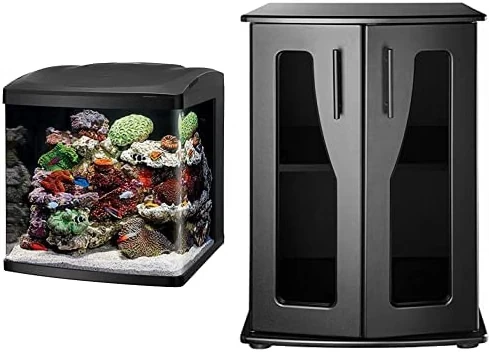
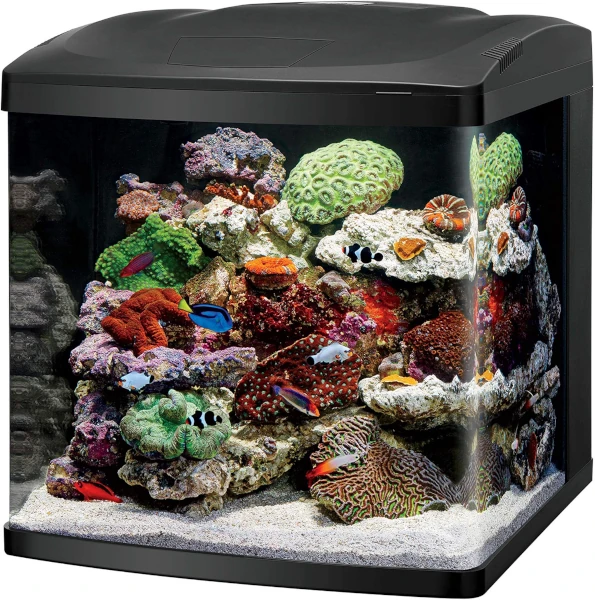
The Coralife LED BioCube Aquarium Fish Tank Kit 32 Gallon with Stand is an all-inclusive 32-gallon aquarium system featuring rounded front glass corners, an integrated rear filtration chamber, and a matching floor stand. The tank is crafted from clear glass with seamless curved front corners for wide viewing, topped with a low-profile hood and built-in multi-stage rear filtration, while the stand features black-tinted acrylic doors with magnetic push latches, an interior storage shelf, rear cord cutouts, and elevated feet. Its total water capacity is 32 gallons. The package includes the 32-gallon glass aquarium, low-profile LED hood with a 24-hour timer, built-in rear filter chamber, quiet submersible pump with dual intakes and adjustable return nozzle, and matching stand. It comes without a submersible water heater, substrate, decor, or live fish.
With its generous 32-gallon capacity, hidden rear filter compartment, and sleek floor cabinet, this setup serves as a ready-made centerpiece in living rooms, offices, or entryways. Three independent LED light channels — bright white, sparkling blue, and color-enhancing — run on an automated 24-hour timer to simulate natural day-to-night cycles and grow live plants or corals. Thanks to its spacious 32-gallon volume, it works wonderfully for a diverse freshwater community of tetras, rasboras, gouramis, swordtails, corydoras catfish, and shrimp, as well as saltwater reef tanks.
Pros
Cons
Coralife 32-Gallon BioCube Aquarium Kit with Built-In Rear Filtration

The Coralife BioCube Aquarium Kit 32 Gallon is a versatile 32-gallon aquarium featuring rounded front glass corners, an integrated rear filtration chamber, and automated LED lighting for freshwater or saltwater setups. The tank is crafted from clear glass with seamless curved front edges for panoramic viewing, topped with a low-profile LED hood and a built-in rear filter compartment housing a quiet submersible pump, dual intakes, and an adjustable return nozzle. Its total water capacity is 32 gallons. The package includes the 32-gallon glass aquarium, low-profile LED hood with 24-hour timer, built-in rear filter chamber, and submersible pump with return nozzle. It comes without a floor stand, submersible water heater, substrate, decor, or live fish.
With its hidden rear filter chamber and clean curved front glass, this tank sits neatly on a sturdy cabinet, sideboard, or reinforced counter in living rooms or offices. Three independent LED channels — bright white, sparkling blue, and color-enhancing — feature automatic 30-minute sunrise/sunset and 60-minute moonrise/moonset cycles that mimic natural daylight transitions without startling fish. Thanks to its generous 32-gallon capacity, it works wonderfully for a diverse freshwater community of tetras, rasboras, gouramis, platies, corydoras catfish, and shrimp, as well as marine reef tanks.
Pros
Cons
Coralife 16-Gallon LED BioCube Starter Aquarium Kit with Built-In Rear Filtration
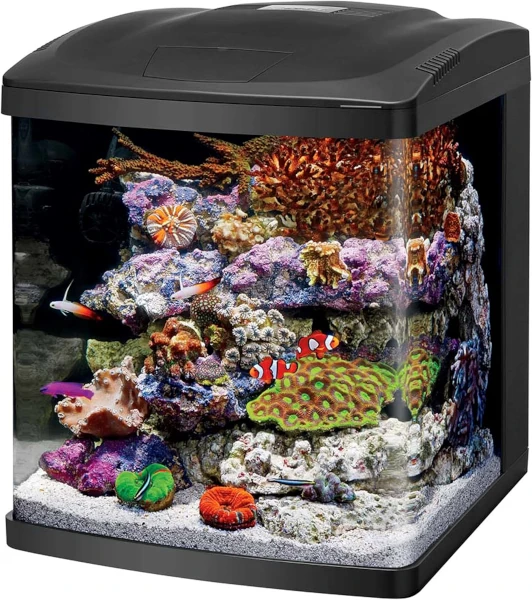
The Coralife LED BioCube Aquarium Starter Kit 16 Gallon is a compact 16-gallon cube aquarium for freshwater or marine setups. The tank is crafted from clear glass with seamless curved front edges. A low-profile LED hood sits on top. A multi-stage filtration chamber is built right into the back wall. A quiet submersible pump runs inside with dual intakes and an adjustable return nozzle. Its total water capacity is 16 gallons. The package includes the 16-gallon glass tank. It also comes with the LED hood, a 24-hour timer, the rear filter chamber, and the submersible pump with nozzle. It arrives without a floor stand, water heater, substrate, decor, or live fish.
This compact 16-gallon cube fits neatly on a sturdy dresser or countertop. The concealed rear filter compartment keeps all gear out of sight. The hood features three independent LED channels. These include bright white, sparkling blue, and color-enhancing lights. A 24-hour timer runs 30-minute sunrise and sunset transitions. It also controls a 60-minute moonrise and moonset cycle. This lighting supports healthy live aquatic plants and corals. The 16-gallon volume works wonderfully for a peaceful community of small tropical fish. Neon tetras, rasboras, guppies, pygmy corydoras, and shrimp thrive in this space.
Pros
Cons
Coospider 20-Gallon Clear Glass Starter Aquarium Kit with 3-Color LED Light
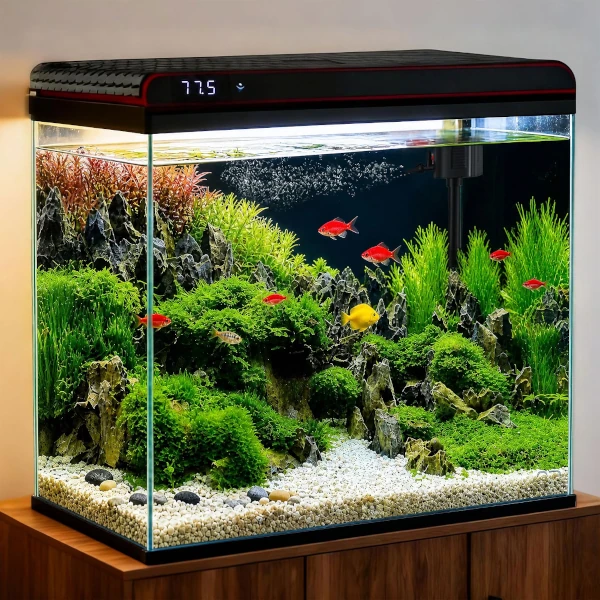
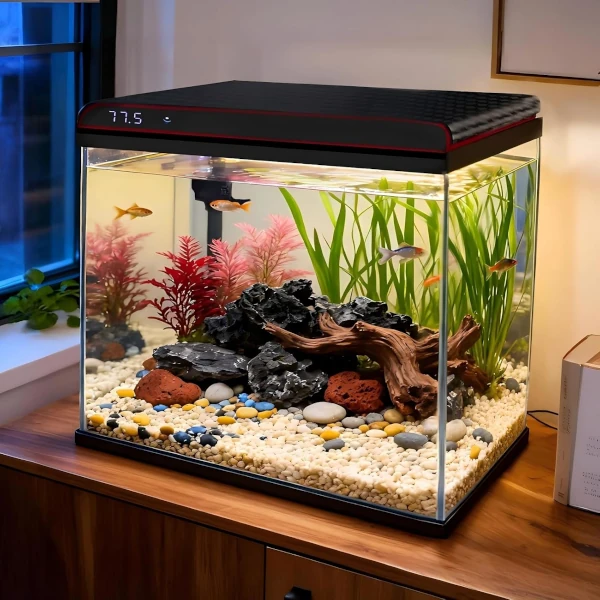
The Coospider 20 Gallon Glass Fish Tank Starter Kit is a modern 20-gallon black glass starter aquarium with built-in temperature monitoring and three-color lighting. The tank is crafted from ultra-clear high-definition glass. A removable flip-top lid sits on top with a feeding door and cat-proof protection. A quiet 3-in-1 pump runs inside to filter, oxygenate, and create a gentle waterfall flow. Its total water capacity is 20 gallons. The package includes the 20-gallon glass tank. It also comes with the flip-top lid, a three-color LED light, a quiet 3-in-1 filter, a feeding pot, and a real-time °F water temperature sensor. It arrives without a submersible water heater, substrate, decor, or live fish.
This 20-gallon glass tank looks great in living rooms, kids’ bedrooms, or home offices. The ultra-clear glass gives a crisp, distortion-free view of aquatic life. Three-color LED lighting supports live plant growth and highlights colorful fish day and night. The built-in thermometer tracks water warmth in °F continuously. A secure flip-top lid keeps curious cats out while the feeding door simplifies daily care. This capacity works wonderfully for a peaceful tropical community. Neon tetras, guppies, platies, mollies, peaceful bettas, shrimp, and snails thrive in this space.
Pros
Cons
AquaVim 98-Gallon Half Moon Glass Aquarium Kit
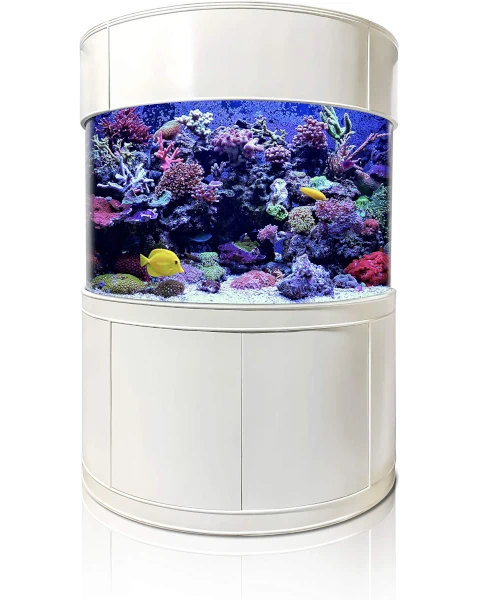
The AquaVim Glass Half Moon Aquarium Fish Tank Kit 98 Gallon is a grand 98-gallon curved-front aquarium featuring a matching wood stand, tall canopy, and lower sump filtration. The tank is crafted from curved clear glass with a sweeping panoramic front view. A matching 15″ canopy in a rich rose cherry finish sits on top. A sturdy 36″ cabinet stand supports the tank underneath. A built-in overflow box features pre-drilled 1″ and 1.5″ holes for water drain and return lines. Its total water capacity is 98 gallons. The package includes the 98-gallon glass tank. It also comes with the 36″ stand, the 15″ canopy, PVC filtration piping, and a standard sump inside the cabinet. It arrives without a return pump, lighting fixture, water heater, substrate, or decor.
This 98-gallon half-moon aquarium serves as a dramatic centerpiece in spacious living rooms, lobbies, or offices. The curved glass front creates an expansive underwater panorama from multiple angles. A lower sump inside the cabinet delivers heavy-duty mechanical and biological filtration for large water volumes. All plumbing and gear stay completely hidden inside the 36″ stand and 15″ canopy. This massive capacity works wonderfully for a large, diverse freshwater community. Big schools of tetras, rainbowfish, angelfish, gouramis, loaches, corydoras, and plecos thrive alongside marine reef setups.
Pros
Cons
Fluval Flex 32.5-Gallon Curved Glass Aquarium Kit with FluvalSmart LED Lighting
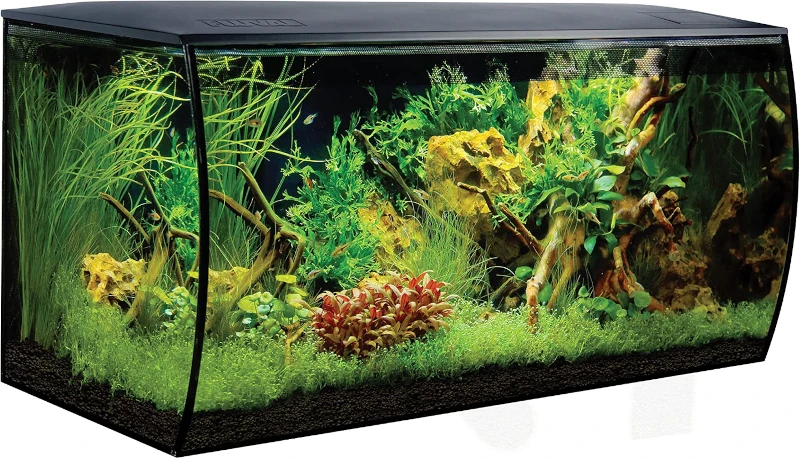
The Fluval Flex 32.5 Aquarium Kit is a contemporary 32.5-gallon aquarium featuring a curved front glass panel, honeycomb rim wrap, and powerful rear filtration for fish and live plants. The tank is crafted from clear glass with a gently bowed front view. A sleek black honeycomb wrap hides the waterline and the sides of the rear filter compartment. A top cover features an easy-feed opening and an integrated Aquasky LED light. Its outer dimensions measure 32.5″L x 15.75″W x 15.35″H for a 32.5-gallon capacity. The package includes the 32.5-gallon glass tank. It also comes with the top lid, a 7500K White + RGB LED light, a circulation pump with dual multi-directional nozzles, and a 3-stage filter with oversized media. It arrives without a floor stand, water heater, substrate, or decor.
This 32.5-gallon panoramic aquarium looks striking on a sturdy cabinet or dresser in living rooms, bedrooms, or offices. The curved glass front creates a wide, uninterrupted view of your underwater landscape. Bright 7500K White + RGB LEDs connect to the FluvalSmart App for custom color blends and healthy live plant growth. A large rear chamber houses mechanical, chemical, and biological filter media out of sight. This spacious volume works wonderfully for a diverse community of peaceful tropical fish. Schools of neon tetras, rasboras, gouramis, swordtails, corydoras, and shrimp thrive in this setup.
Pros
Cons
LANDEN EzFlux 45 20-Gallon Rimless Low-Iron Glass Aquarium with Rear Filtration
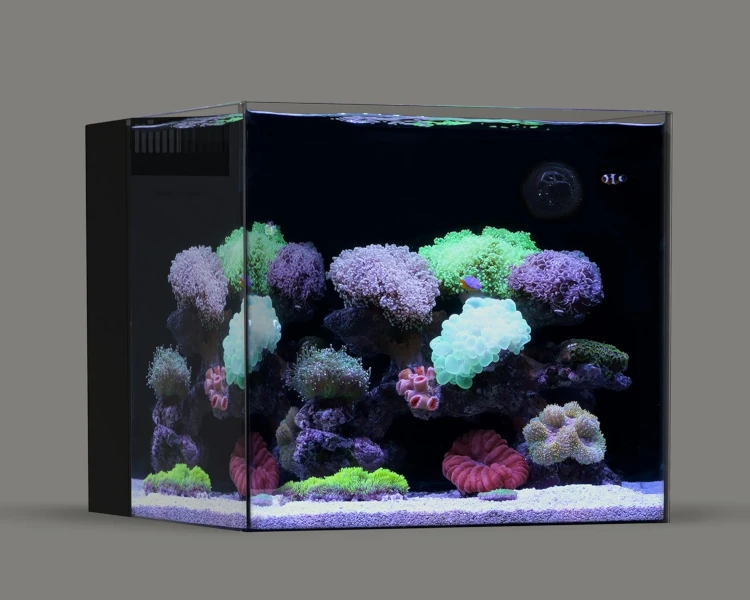
The LANDEN EzFlux 45 Rimless 20 Gallon Rear Filtration Tank is a rimless 20-gallon cube aquarium crafted from ultra-clear glass with a three-chamber rear filtration system. The tank is made of 6mm low-iron glass with beveled edges and smooth German silicone joints. Three glass chambers at the back hold filter media, a heater, or a protein skimmer. Its outer dimensions measure 17.72″L x 17.72″W x 15.75″H for a total capacity of 20 gallons. The package includes the 20-gallon glass tank. It also comes with a 9W LANDEN BIOSMO 700 return pump rated at 185 GPH, a directional return nozzle, a detachable intake, and an EVA foam leveling pad. It arrives without a lighting fixture, filter media, water heater, top lid, substrate, or decor.
This 20-gallon rimless cube creates a clean, modern look on a sturdy stand, dresser, or desk. Low-iron glass delivers crystal-clear viewing without any green tint. Three rear chambers conceal gear out of sight and leave 14.1 gallons of open display space for aquascaping. The adjustable nozzle directs water flow while the EVA pad reduces vibration and noise. This tank works wonderfully for a peaceful freshwater community with live plants or a saltwater reef setup. Neon tetras, rasboras, guppies, pygmy corydoras, shrimp, and snails thrive in this environment.
Pros
Cons
LUXFIS 12-Gallon Rimless Low-Iron Glass Aquarium
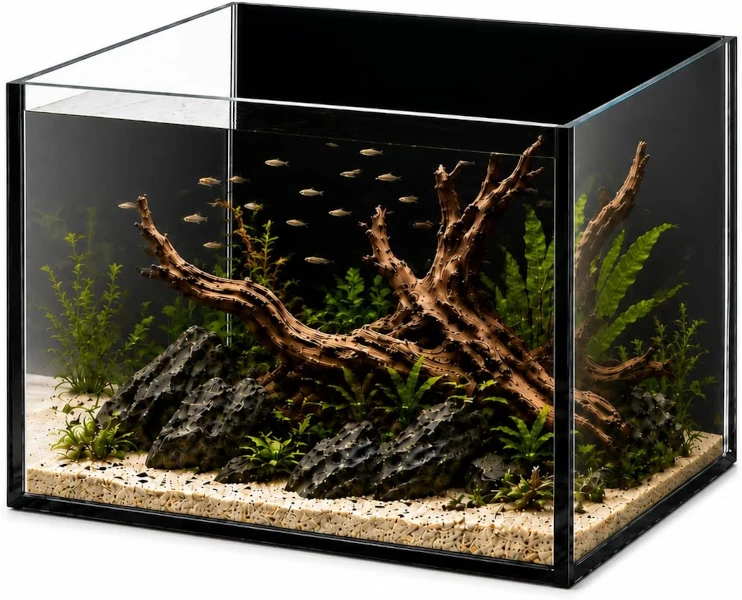
The LUXFIS Long Tall Fish Tank Black Background Rimless Desktop Aquarium is a long tall 12-gallon rimless tank with a black background for freshwater or saltwater setups. The tank is made from 6mm thickened ultra-clear glass. The glass features polished edges and a 1mm micro chamfer. The seams use neat bubble-free aquarium silicone. The back panel comes with a black background. Its outer dimensions measure 17.72″L x 11.81″W x 13.78″H. Its total water capacity is 12 gallons. The package includes the 12-gallon rimless glass aquarium. It arrives without a filter, light fixture, water heater, lid, substrate, decor, or live fish.
This 12-gallon rimless tank fits well on a desk, bookshelf, corner, or dresser. Thickened glass gives over 91 percent light transmittance for clear viewing. The black background makes bright fish and green plants stand out. It also hides cords and hoses behind the back glass. This capacity works well for a small peaceful freshwater community or a marine reef setup. Neon tetras, rasboras, guppies, pygmy corydoras, a peaceful betta, shrimp, and snails do well here.
Pros
Cons
FAQ
A tank from 12 to 20 gallons fits a small school of tiny fish and shrimp. A tank of 32 gallons or more works better for larger groups and medium fish. More water volume keeps water quality steady for longer.
Pick peaceful fish that enjoy similar water warmth and cleanliness. Neon tetras, rasboras, guppies, platies, mollies, corydoras, and shrimp mix well. Larger tanks also fit gouramis, rainbowfish, or peaceful angelfish. Skip nippy or aggressive fish that bother tank mates.
These tanks hide the pump, filter media, and extra gear behind a back wall. More open space stays clear for swimming and cords stay out of sight. This keeps daily care tidy and clean.
Yes, most tropical fish need steady water between 75°F and 80°F. Most starter kits arrive without a submersible heater or thermometer. Buy both ahead of time before adding fish.
Place the stand on a flat, sturdy floor that holds full water, gravel, and decor weight. Each gallon of water weighs about 8.3 lbs before adding glass and substrate. Large tanks at 32 gallons and 98 gallons need a strong, properly rated stand.